


Blog
Electrification of O&G Operations: What's Being Electrified, and What Still Can't Be
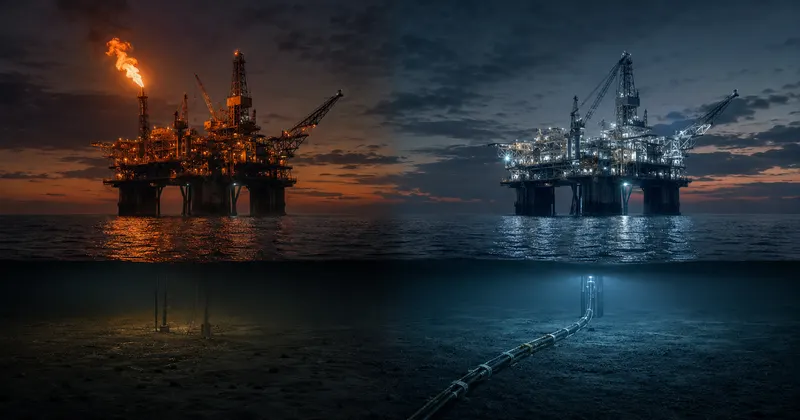
Electrification of oil and gas operations is real, but selective. Offshore platforms running on power from shore and grid-tied compressor stations are moving from pilot projects to standard equipment across the North Sea and China's Bohai Bay. Remote fields and heavy mobile equipment mostly still run on diesel or gas, despite real effort to change that. The question of where electrification actually works, and where it still doesn't, is among the ones to be discussed at DECARBON 2027 (15-16 February, Berlin).
The North Sea leads offshore electrification
Norway pioneered the model. Troll A has run on power from shore since 1996, the first electrified offshore installation in the world, and the approach has since spread across the Norwegian Continental Shelf. Aker BP switched its Edvard Grieg and Ivar Aasen platforms to shore power in 2022 and brought the large Yggdrasil development online this year using the same approach, ahead of first production in 2027. Johan Sverdrup, which Equinor runs entirely on power from shore, produces an estimated 0.67 kilograms of CO2 per barrel of oil, against a North Sea average of around 9 kilograms and a global average closer to 15.

But even on Norway's mature grid, full electrification stays incremental. Equinor extended power from shore to the Troll B and C platforms in 2024, cutting an estimated 250,000 tonnes of CO2 a year. Despite that, the large gas export compressors on those platforms still run on gas turbines. Equinor is targeting full electrification of Troll C, closing that gap, for 2027, more than three decades after Troll A first proved the concept.
Compressor stations: replacing gas turbines with the grid
Compression is the clearest case for grid electrification. Unlike mobile equipment, compressor stations are fixed, long-lived assets – exactly the profile that justifies the upfront cost of a grid connection. Operators are still combining different tools to get there, though.
Snam, whose Italian network alone runs to nearly 33,000 kilometers, plans to replace enough gas-driven compressors with electric units to cut natural gas use in its transport and storage operations by 62% by 2040, while also building new turbines designed to run on hydrogen blends for the infrastructure that stays on gas. A new compressor station on Snam's Adriatic Line, for instance, uses turbines built to handle up to 10% hydrogen blended with natural gas.
In the United States, some operators have gone further towards pure electrification on individual sites: swapping a single 5-megawatt gas turbine for an electric drive can cut an estimated 25,000 tons of CO2 a year, according to industry engineering estimates.
Either path shifts emissions accounting from Scope 1 combustion to Scope 2 grid electricity, and the climate benefit depends on what generates that grid power. It also depends on the grid staying up, a reliability concern that keeps some pipeline operators cautious about full conversion even where the technology works.
Aker BP, Equinor and Snam are joining DECARBON 2027 (15-16 February, Berlin) - get the full list of confirmed participants.
China moves faster with power from shore
China is moving in the same direction, in places faster. CNOOC recently brought online the Penglai power-from-shore platform in Bohai Bay, a 220-kilovolt system its partner ConocoPhillips calls China's largest and highest-voltage offshore electrification project. In the South China Sea, CNOOC connected a 16-megawatt floating wind turbine directly to the Lufeng oilfield, following an earlier project that linked two Bohai Bay megafields to power from shore.
CNOOC applies a different calculus outside China. In 2025, its UK arm walked away from a plan to electrify the Buzzard platform in the North Sea using floating wind power, citing an inability to find "an investible solution in the current economic climate." The company remains one of the most active electrifiers on its home continental shelf. Off the coast of Scotland, the numbers didn't work.
The Middle East: oil and gas linked to nuclear and solar
The UAE has taken the shore-power model furthest. ADNOC's Project Lightning, a $3.8 billion subsea HVDC transmission system, finished laying roughly 1,000 kilometres of cable in January 2025 and is now targeting full commercial operation in 2026. Two links carrying a combined 3.2 gigawatts will replace gas turbine generators on the Das and Zakum Island complexes with power from Abu Dhabi's onshore grid, which ADNOC has sourced entirely from nuclear and solar since January 2022. ADNOC expects the switch to cut its offshore carbon footprint by up to 50%, a bigger single-project reduction than anything achieved so far in the North Sea, precisely because the grid behind it is that clean.
Saudi Aramco is working on the same problem from the other end, and with a different playbook. Rather than building new transmission to the grid, its two-decade-old energy management programme leans on cogeneration, generating power and steam together on-site to cut dependence on both diesel and the national grid. The company's own 2024 sustainability report shows this hasn't been enough to offset rising output: total emissions and upstream carbon intensity both increased in 2024, driven by higher gas production for domestic demand.
Where cost and grid access limit electrification
Norway's own economics, not just its grid, are now the clearest limit on further electrification. In October 2025, Equinor told the Norwegian government it would abandon electrification plans for the Snorre, Heidrun, Åsgard B and Kristin fields, citing costs that ran far above the country's own carbon tax on offshore emissions.
The cancelled projects would have cut an estimated 710,000 tonnes of CO2 a year, and the decision means Equinor will probably miss Norway's 50% offshore emissions target for 2030, landing closer to 45% instead. Equinor is still proceeding with electrification at the Grane and Balder fields, expected to cut 380,000 tonnes once complete. Offshore Norway, the industry body, still forecasts oil and gas power demand on the shelf reaching around 18 terawatt-hours by 2032, equal to 11% of national electricity output, and lawmakers have begun questioning whether that demand deserves priority access to a tightening power supply. Equinor's chief executive has warned that reopening the rules now threatens the "stable framework conditions" the programme depends on.

That tension already has a name: Hammerfest LNG. Equinor's Snøhvit Future project would electrify the plant from 2030, using a new 420-kilovolt line from Statnett, and cut an estimated 850,000 tonnes of CO2 a year, the largest single emissions-reduction measure in Norway's plan to meet its climate targets. Lawmakers from the Progress Party to the Greens have pushed to halt, delay or reverse the project since early 2025, for opposite reasons: some want to keep the cheaper gas turbines running, others want the plant closed altogether. None of the proposals passed. Parliament voted them down again in February 2026, and the project remains on schedule.
The UK Continental Shelf shows a related divergence within Europe itself. Norway keeps connecting new platforms because the supporting grid infrastructure already exists. UK operators mostly can't yet – building new export cables still doesn't pencil out economically for most fields.
In the United States, the constraint runs differently again: not a shortage of power to allocate, but a shortage of grid to deliver it, with new grid connections in the Permian Basin now commonly taking two to three years, up from a matter of months before the buildout began.
Drilling rigs and heavy mobile fleets: the equipment gap
Land rigs and much of the heavy equipment that services a well pad still run on diesel by default, and not always by choice. The problem is largely physical: hoisting and mud pumping produce sharp power spikes that are hard for a fixed grid connection or a battery pack to absorb, especially on equipment that moves between sites every few weeks.
Sinopec's Shengli oilfield has patented mobile electric workover rig designs built for that kind of relocation, and Chinese engineers have field-tested at least one walking electric version at a domestic oilfield. Published research on battery energy storage systems for drilling rigs points to diesel fuel savings of up to 20-30%, depending on battery capacity. Full replacement of the generator remains out of reach.
What this means going into DECARBON 2027
The North Sea and Bohai Bay have both demonstrated real, measurable emissions cuts, and so have hybrid compressor stations, sometimes in the hundreds of thousands of tonnes of CO2 per year for a single project. But grid capacity and who gets access to it decide what gets electrified, and Norway's own experience shows that even a well-resourced, decades-long programme keeps running into new versions of that same limit.
DECARBON 2027 gathers operators, contractors and technology providers working through these constraints, from grid capacity planning to next-generation platform and pipeline electrification.
The full programme is available now – get DECARBON 2027 business programme.
FAQ
What is DECARBON 2027?
DECARBON 2027 is the Oil & Gas Decarbonisation Congress – a closed-door B2B event bringing together senior operators, EPCs and technology providers from across the global oil and gas value chain. The programme covers CCUS, low-carbon hydrogen, methane abatement, energy efficiency, regulatory compliance and digital tools for net-zero.
When and where does DECARBON 2027 take place?
DECARBON 2027 takes place on 15-16 February 2027 in Berlin, Germany. The two-day programme runs sessions on CCUS, hydrogen, methane abatement and grid electrification, alongside a technology exhibition and structured B2B meetings.
Who attends DECARBON 2027?
DECARBON 2027 is attended by C-level executives, sustainability leads, technical experts and operational decision-makers from major oil and gas operators, upstream producers, midstream companies and refiners, alongside the technology, EPC and service companies supporting the sector's energy transition. The congress operates on a closed-door model, with participants selected to maintain a focused professional environment of end-users, solution providers and licensors.
How do companies participate in DECARBON 2027?
Companies participate in DECARBON 2027 as delegates, sponsors, exhibitors or speakers. Every participant receives a dedicated personal manager and the full attendee list ahead of the event to arrange on-site meetings; sponsors additionally get support organising a guaranteed number of meetings. Companies can register interest directly with the DECARBON 2027 team.
Can offshore oil and gas platforms run entirely on electric power?
Offshore oil and gas platforms cannot yet run entirely on electric power in most cases. Even Norway's most electrified fields, like Equinor's Troll platforms, still run high-horsepower gas export compressors on turbines. Full electrification there is targeted for 2027, almost three decades after the first North Sea platform went electric.
How does oil and gas electrification differ across regions?
Norway leads on regulated, grid-based offshore electrification, though its own programme now runs into domestic power allocation limits. China is investing fastest in new offshore infrastructure, led by state-owned CNOOC. The UAE has gone further than either, connecting offshore fields to a grid powered entirely by nuclear and solar. In the US, the main constraint is grid capacity itself, which pushes some operators toward on-site gas generation instead.
References
-
Equinor drops offshore electrification plans – https://www.bairdmaritime.com/offshore/renewables/offshore-wind/equinor-drops-offshore-electrification-plans-over-soaring-renewable-energy-costs
-
Norway oil, gas power use set for sharp rise by 2030 – https://www.argusmedia.com/en/news-and-insights/latest-market-news/2793331-norway-oil-gas-power-use-set-for-sharp-rise-by-2030
-
CNOOC drops Green Volt offtake plans – https://www.renews.biz/offshore-wind/cnooc-drops-green-volt-offtake-plans/
-
Snam 2025-2029 Strategic Plan – https://www.snam.it/content/dam/snam/pages-attachments-search/it/documenti/presentazioni/2025/2025-2029_Strategic_Plan.pdf
-
China launches world's first 16 MW TLP floating offshore wind turbine – https://interestingengineering.com/energy/china-world-first-16-mw-floating-offshore-wind-platform
-
The case for electrifying brownfield compressor stations – https://www.gasprocessingnews.com/articles/2024/08/the-case-for-electrifying-brownfield-compressor-stations/
-
The Snøhvit Future project (Equinor) – https://www.equinor.com/energy/snohvit-future
-
Forslag om å stanse Melkøya-elektrifisering får ikke flertall (High North News) – https://www.highnorthnews.com/naeringsliv/forslag-om-a-stanse-melkoya-elektrifisering-far-ikke-flertall/1102659
-
Offshore Electrification — Project Lightning (ADNOC) – https://www.adnoc.ae/en/our-projects/offshore-electrification
-
Investing in growth, innovating for sustainability – Aramco Sustainability Report 2024 – https://www.aramco.com/-/media/publications/corporate-reports/sustainability-reports/report-2024/english/2024-saudi-aramco-sustainability-report-full-en.pdf
-
Why Permian basin oil companies are struggling to find power (newvision.io, citing upstreamonline.com) – https://newvision.io/industry-digest/why-permian-basin-oil-companies-are-struggling-to-find-power
-
Energy storage systems for drilling rigs (ResearchGate) – https://www.researchgate.net/publication/357404456_Energy_storage_systems_for_drilling_rigs
-
CN202064828U – Track type electric comprehensive workover rig (Google Patents) – https://patents.google.com/patent/CN202064828U/en